
- Aug 24, 2014
- Nova Nelson
How to make a coco-husk raised bed
Sunshine, salty breeze and coconuts!
During a recent trip to Sri Lanka I spent some time visiting herb gardens and an organic farm producing fruits and vegetables for one of the hotels we stayed in. While I came home with plenty of inspiration, one garden design idea stood out – coconut husk raised beds. Why did I not think of this before?Why coconut husks?
As a resource for your garden, coconut husks are accessible, cheap and absolutely sustainable. Not to mention incredibly durable too. After all it is from the coconut husks that coconut coir or fibre is derived and is used to make many of our household products like ropes, brooms and bristle brushes. Another great advantage of coconut husks is it can store moisture but does not induce mold, fungi and rot. This is really relevant for us growing food in humid tropical weather.Designing and building with coco-husks.
Back from the trip with an awesome idea for raised beds, I shared the idea with Mr Subbarow’s Urban Farming team our community garden partners at the E&O Think Green community garden. We had to make the process simple and easy enough so the children we work with on the garden could build the coco-husk raised beds. This is how we prepared for the coco-husk raised bed workshop with the children:- Source some dried coconut husks, Mr Subbarow sourced the husks from a local coconut water seller. We got 5 gunny sacks full of coco-husks.
- Quarter each coconut husk. Because we were working with children we wanted this to be a simple process. As we tried quartering it we realised it would be a fun activity for kids to do in pairs. And so during the gardening workshop they quartered the husks in pairs, each pulling opposite ends of the husks.
- 3. Prep the raised bed area. Using the contour of the community garden we designed semi circle beds against a mini mount at the garden. This saved us time and effort because we only needed to raise the lower end of the mount and let the back end of the bed rest against the mount. The grass was removed and soil loosened. Observe and adapt, chose the best site for your raised bed with sufficient sun for your edibles.
- Prepare your seedlings, we planted some red ladies finger plants, brinjals and some marigolds as our pest trap.
Building the coco-husk raised beds
- Dig up a narrow strip/ditch at the border of your raised bed. We dug up a shallow 3 inch deep ditch.
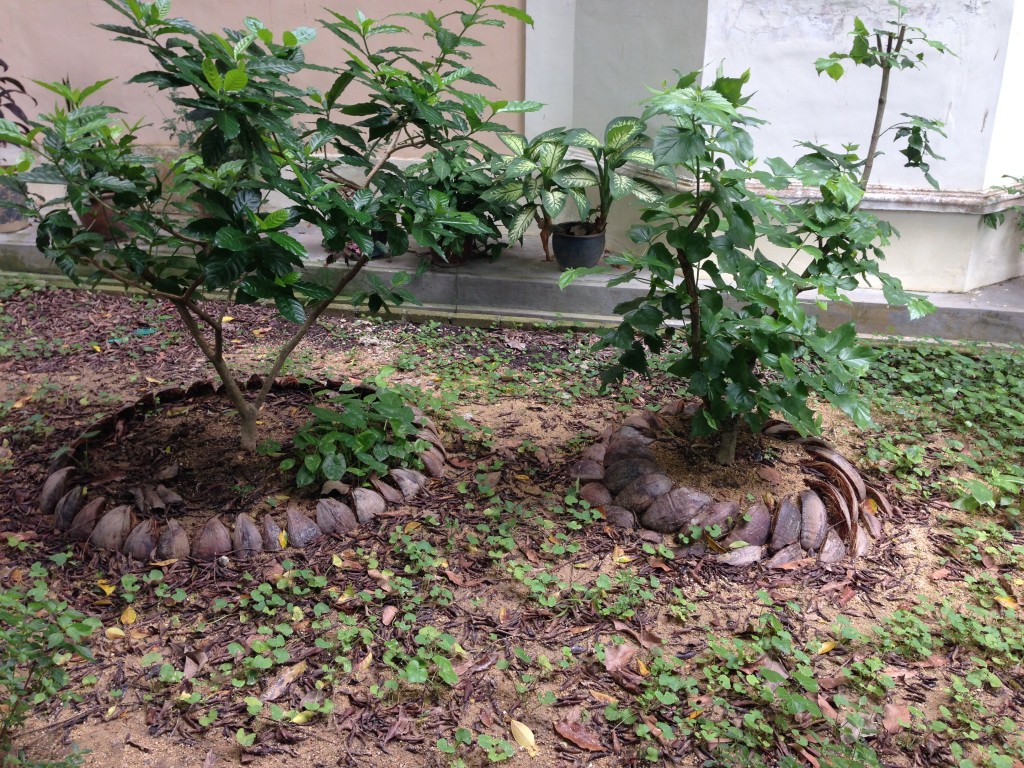
- Place the broader part of the husk on the ground and line it up closely next to each other into the ditch. Pack in soil into the back of each coco-husk quarter.
- Once you are done with one layer start with the second layer of coco-husks. Line up the coco-husk snugly behind the first row of husks and pack in soil behind each husk.
There are various versions and ways to stack up these coco-husks. You can pile the husks flat on top of each other too. And you can stack as many layers as you want so long as you can pack in soil behind the husks to keep the raised bed in position. We made two layers to keep it manageable for the children.
Just look at the proud smiles on their faces. We only showed them how to place about 4-5 husks and they took over giving each other roles, working as a team and ensuring it was built with quality.
It was such a easy fuss free experience, Mr Subbarow’s team returned to their urban farm and created more raised beds out of coconut husks.
So next time you think of building a raised bed, try using coconut husks. It is easy to work with, cheap and durable. Try this at home or with your community of urban gardeners. For more urban gardening ideas follow us on our facebook page or on our Pinterest page.

Nova Nelson
Nova Nelson is a permaculture practitioner and consultant with over ten years of experience in Singapore and Malaysia. She is the founder of Cultivate Central, where she integrates permaculture, syntropic agroforestry, and community development to shape regenerative urban food systems. Nova leads the Goodman Community Farm, a demonstrative urban permaculture ecosystem connecting people to soil, food, and environmental stewardship. Certified in Sustainable Food Production and Processing from the Cambridge Institute for Sustainability Leadership, she consults on regenerative food initiatives and hosts Cultivating Change, a podcast exploring food systems and regenerative farmers, communities and cultures across Southeast Asia.
How did I find myself doing what I do? Read my story here.
Features
From Community Farming to Community Research
Enter the Goodman Community Farm — a community space for ageing well.Since 2019, Cultivate Central and the Goodman Arts Centre have nurtured...
Cultivating Change EP #12: Discovering Regenerative Farming with the Orang Asli in Malaysia
What does it take to rebuild livelihoods, restore soil, and shift mindsets? EP #12: Discovering Regenerative Farming with the Orang As...