
- Nov 11, 2013
- Nova Nelson
Growing Food Naturally : 3 Recipes to help your plants thrive.
This is an article by Theeban Gunasekaran, an Education Officer and Natural Farming Coordinator with Consurmers Association Penang. With his team mates from the Natural Farming Team, Theeban collaborates with us on the E&O Think Green Programme. All the photographs in this article were taken by Zac Chong, from E&O Properties Sdn Bhd who has been passionate about encouraging their landscapers to use natural gardening methods at the Straits Green Park.
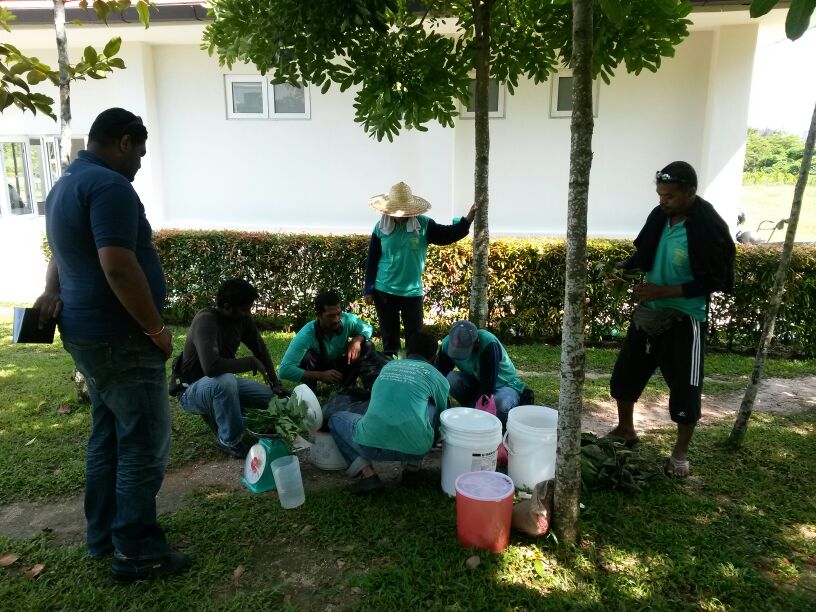
We ran a natural pest repellant and fertiliser training session for landscapers who were supporting us at the E&O Think Green Community Composting and Food Garden. We taught them how to produce natural growth promoters and pest repellents, we thought we share these natural recipes with you so you can try it at home.
Natural Pest Repellant : 3 Leaves Solution.
Landscapers gathered together and prepared some herbal leaves for the natural pest repellent. To make this pest repellent, we selected 3 types of bitter leaves:
Neem leaves, Lantana leaves and Nona Leaves.
Prepare 1 kg of each leaves, chop it, and put it inside rice cooker, add 4 liters of water & boil it for 1 hour.
After an hour, we checked the 3 leafs solution it was ready so we filtered the solution into a container and left it to cool.
DOSAGE: 300ml + 10 liters water. The solution smells strong, but it’s not harmful to humans.
Growth Promoter: Farmer’s EM (FEM)
While the leaf solution was boiling, we started with the first growth promoter called Farmer’s EM (Effective Micro organism).
Ingredients:
- 3kg Papaya (rich in potassium)
- 3kg Banana (rich in potassium)
- 3kg Pumpkin (rich in potassium)
- 3kg Brown Sugar/Molasses (Unprocessed Sugar)
- Eggs – 5 ( for calcium)
- Water : 10 liter (no chlorine water)
- 1 Air Tight Container (up to 20 liter)
Chop all the 3 fruits to small cube size pieces, and add into the container. Add 10 liters of water, and then add brown sugar or molasses and stir it gently. And 5 eggs (without the shell). Again stir it gently – clockwise 50 times, anti-clockwise 50 times to make sure the solution is mixed really well.
Close it with the air tight cover. Leave it for 10 days. On the 10th day, open the cover, fungus should appear on the surface. If there is no fungus add 1 kg brown sugar, stir it 50 times (Clockwise & Anti-clockwise) and keep it aside. Stir this mixture once every 10 days. After 30 days, stir this Farmer’s EM every day until 45th day (stir everyday for 15days). On 45th day this FEM is ready to use. Filter and strain before using it.
This Farmer’s EM is used to rehabilitate soil conditions, control fungus and disease in plants and is a growth promoter.
DOSAGE: 200ml + 10 liter water (mostly using for soil)
Growth Promoter: Fish Amino Acid
Then we started with the 2nd Growth promoter – Fish Amino Acid. It’s really easy to make and rich in protein.
Ingredients:
- Fish parts and waste : 1kg
- Brown Sugar : 1kg
- 1 non-air tight container
- A cloth to cover the container
- String to tie
On day 10, filter this mixture and it is ready for use. You can reuse the remaining fish waste by adding another 2 kg brown sugar and repeat the method again for 10days. You can do this 3 times over after which you can compost or throw away the fish discards.
DOSAGE: 20-50ml + 10 liter water for all types flowers & vegetables.
It was good to see the landscapers actively participating and interested in learning something new from old farming techniques. We will be checking in on them and will plan more training sessions with them. Hope you try these recipes for your garden at home.

Nova Nelson
Nova Nelson is a permaculture practitioner and consultant with over ten years of experience in Singapore and Malaysia. She is the founder of Cultivate Central, where she integrates permaculture, syntropic agroforestry, and community development to shape regenerative urban food systems. Nova leads the Goodman Community Farm, a demonstrative urban permaculture ecosystem connecting people to soil, food, and environmental stewardship. Certified in Sustainable Food Production and Processing from the Cambridge Institute for Sustainability Leadership, she consults on regenerative food initiatives and hosts Cultivating Change, a podcast exploring food systems and regenerative farmers, communities and cultures across Southeast Asia.
How did I find myself doing what I do? Read my story here.
Features
From Community Farming to Community Research
Enter the Goodman Community Farm — a community space for ageing well.Since 2019, Cultivate Central and the Goodman Arts Centre have nurtured...
Cultivating Change EP #12: Discovering Regenerative Farming with the Orang Asli in Malaysia
What does it take to rebuild livelihoods, restore soil, and shift mindsets? EP #12: Discovering Regenerative Farming with the Orang As...