- Jun 14, 2025
- Nova Nelson
Cracking the Coconut (Part 1): Growing the Tree of Life
"From pandemic planting to my ongoing love affair with the Cocos nucifera"
I kicked off my coconut obsession in November 2021, during the pandemic’s second year. The Goodman Community Farm teamed up with the Goodman Art Centre for a small event and invited one of Singapore's brilliant visual artist Khairuddin Wahab to unearth the site's backstory and create a rustic garden installation.
It turns out the Art Centre once housed Tun Seri Lanang Secondary—one of Singapore’s last Malay schools. While Khairuddin dug into its social and cultural roots, I stumbled on its agricultural past: before seaside bungalows, colonial villas and recreational clubs, #TanjongKatong was a patchwork of coconut and cotton plantations. So, as part of Khairuddin’s installation paying homage to the Tun Seri Lanang school, I planted a coconut palm (and, for kicks, a few cotton seedlings—though that saga deserves its own article).
If you're short on time, scroll down to the bottom of this article and get the gist of the article in our TL;DR summary.
Choosing the right variety
I stressed to the nursery, ‘It must be a dwarf variety!’ I did not know enough to name the cultivar (a plant variety cultivated by through selective breeding). All I knew was I needed a dwarf variety. You see, with an annual, a flop means I can yank the plant out and do-over. A palm—or tree—in a public community farm is a whole different story. Everyone’s watching (and judging). I refused to saddle the farm (or myself) with a skyrocketing coconut palm that needed a crane, a monkey or a squad of acrobats at harvest time. And then it arrived: a two-three foot coconut seedling. I embraced my "plant first, learn more later" sensibility and whispered to it, "Please do not become a skyscraper."
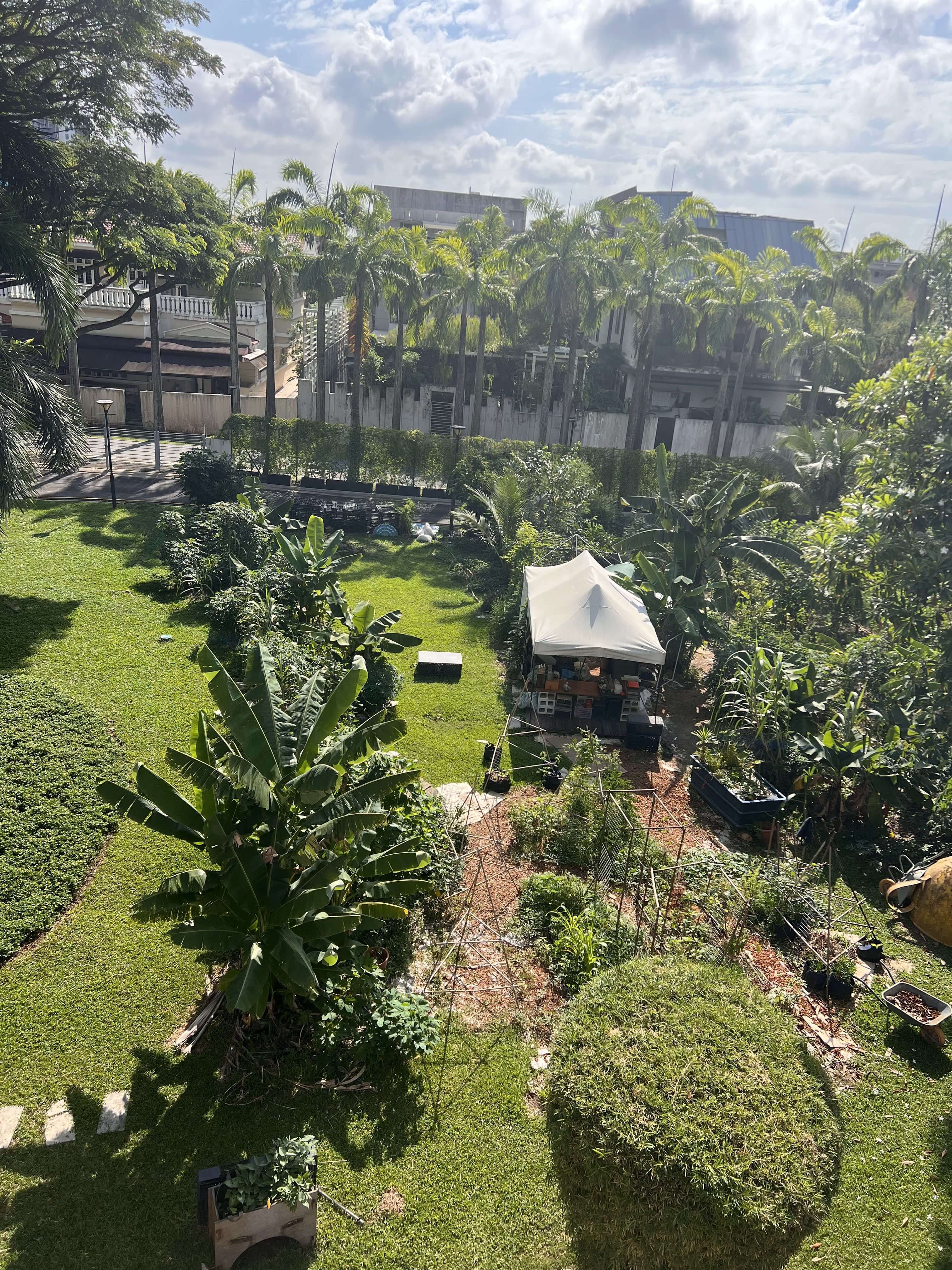 Coconut trees can grow up to 30 feet tall like these "skyscrapers" that border the Goodman Community Farm
So, how did the Dwarf variety come about?
Once it was in the ground I had more time to think about coconuts! "How are coconut varieties categorised? What cultivars are there? I just planted a Malaysian Dwarf, did this dwarf morph naturally? What other dwarf varieties are there?"
I've learnt that there are two ways to categorise the coconut by fruit form and function and by stature and size of the palm. Over thousands of years, a deep partnership between people and coconuts has been shaped. This influenced not just where coconuts grow, but how the fruit looked. Over centuries two main fruit shapes evolved:
- Niu kafa – long and fibrous, good for floating in the ocean (nature’s design).
- Niu vai – round and juicy, ideal for drinking (human-selected).
Likewise, coconut trees are also typically categorised by:
- Tall – fast-growing, cross-pollinating giants, mostly used for copra, oil and fibre.
- Dwarf – smaller, self-pollinating trees found closer to homes, prized for sweet water and easy harvesting.
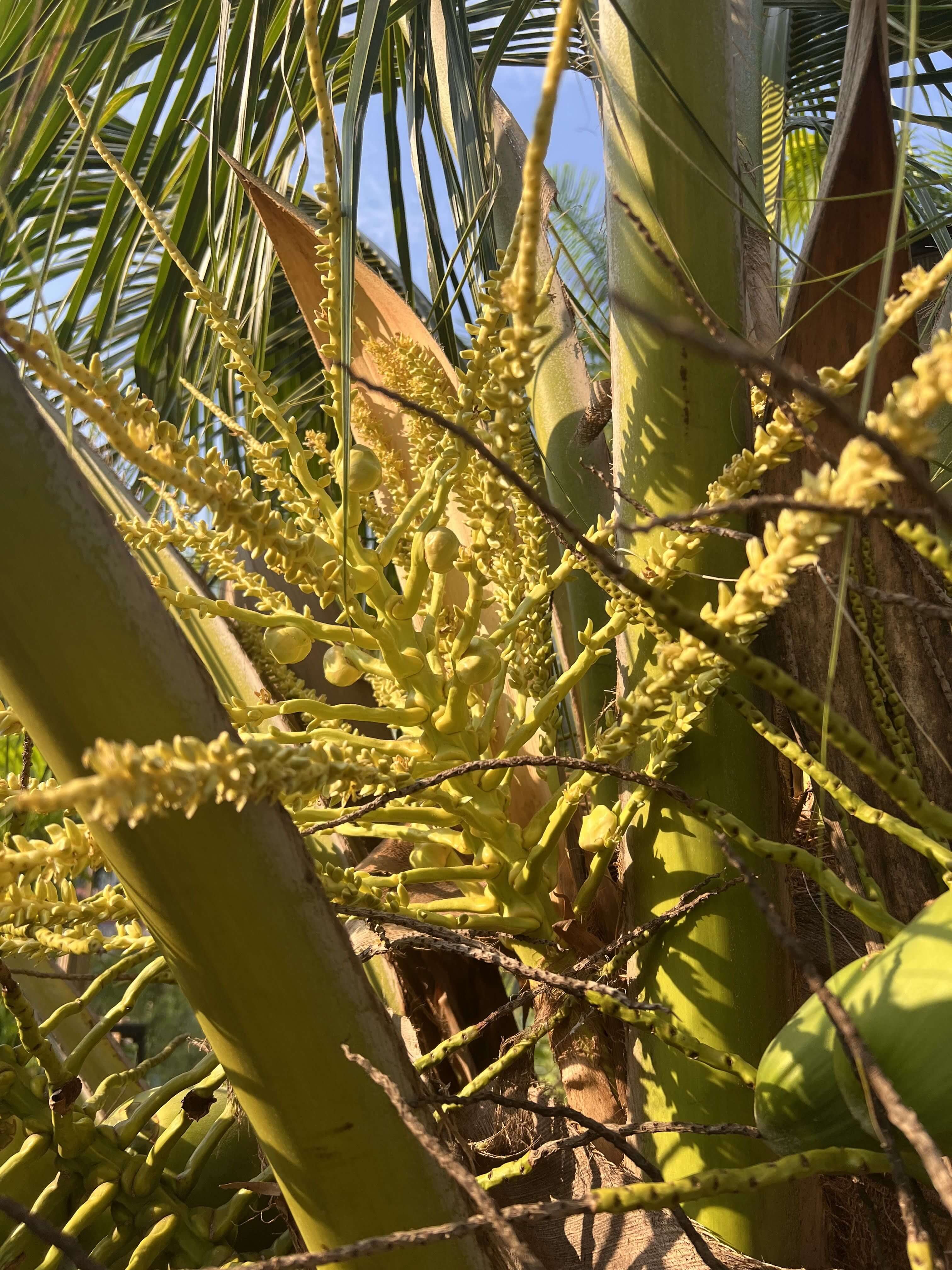 Inflorescence of the Malayan dwarf coconut tree
The evolution of the coconut was Influenced by both natural selection and human cultivation. The ‘niu kafa’ form has been interpreted as more ancient and the ‘niu vai’ form reflects selection under thousands of years of human cultivation.
Two Independent Domestications
We all know coconuts floated across oceans naturally, but they also hitched rides with people. What blew my mind was that the coconuts we see today likely came from two different origin stories forming two separate “families” or genetic groups. There were two independent domestications of coconuts — one in the Pacific and one in the Indian Ocean:
- Pacific Group: These coconuts were domesticated by the Austronesian in Southeast Asia and spread through seaborne migrations as far east as the Pacific Islands.
- Indo-Atlantic Group: These coconuts came from the southern part of the Indian subcontinent (coastal India, Bangladesh and Sri Lanka).
These two separate bands of cultures and communities, thousands of miles apart, looked at essentially the same hairy, spherical fruit and wondered, “Huh, maybe I can do something with that, maybe I can work with nature and make it better.” No notes were exchanged, no online coconut forums and coconut research institutes to guide them.
Two - three thousand years ago farmers and growers in Southeast Asia were observing the coconut trees around them and noticed some weren’t reaching for the sky quite so aggressively. And they likely thought, “Hey, these stunted ones could be useful!" These were selected by humans to breed coconuts to suit their needs.
Meet My Malayan Green Dwarf
Based on my scanning different research papers there are about 12-15 varieties of dwarfs, Three of which are Malayan Dwarfs -The Yellow Malayan Dwarf (YMD), Red Malayan Dwarf (RMD) and Green Malayan Dwarf (GMD).
After about 2½ years, I finally identified my palm as the Green Malayan Dwarf. It self-pollinates and blooms at about 32 months. It’ll top out at 20–30 ft—infinitely more manageable than its 100-ft tall cousins. And while it doesn’t yield tons of copra, its round fruits hold sweet, clear water (a hallmark of niu vai types). Compare that to the towering Tall Cocos nucifera – they take 5-7 years to flower and have an economic lifespan of a whopping 80-100 years.
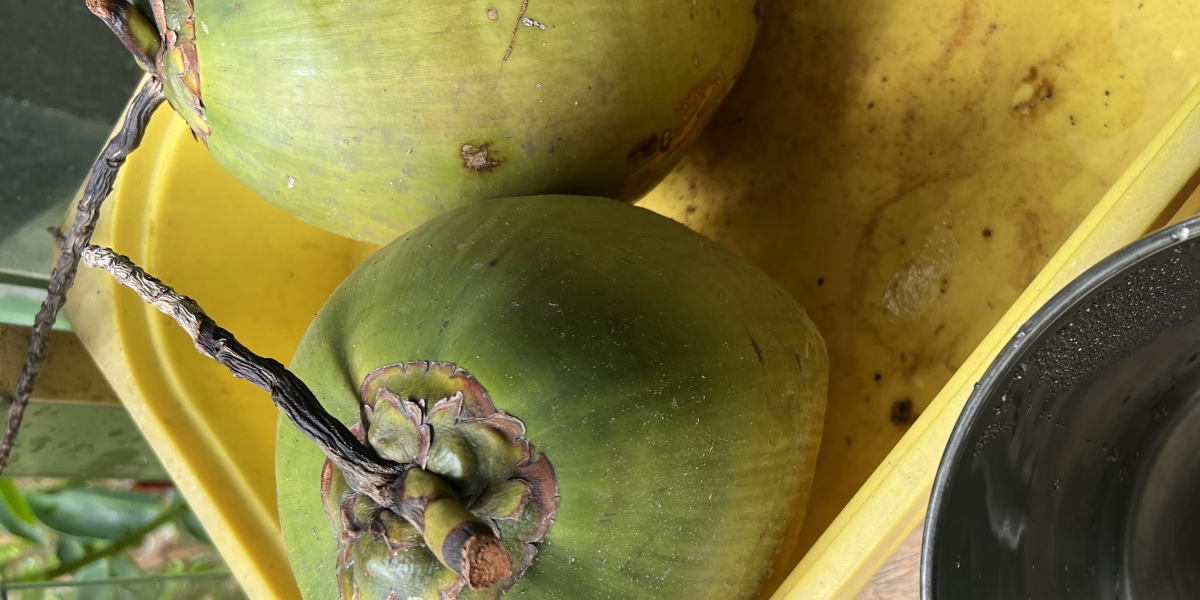
 Yield from our Malayan Dwarf Coconut tree
The Waiting Game
Even when those fruits hang low and tempt you, you must wait 6–7 months for peak sweetness and tender, jelly-like flesh. When the tree first fruited I was too eager, harvested too early and kicked myself for it.
One more question - Why niu vai and niu kafa?
Polynesian cultures have a long, rich history with coconuts, and their classifications were deeply tied to practical use — water, fibre, food, or travel."Niu” means coconut in many Polynesian and Austronesian languages.
“Vai” means water in Samoan and related tongues — so “niu vai” literally means water coconut, referring to the round sweet, water-filled coconuts selected by humans for drinking. “Kafa” refers to the fibrous husk of the coconut. So “niu kafa” means fibrous coconut, typically long and oblong, better suited for floating in the ocean — a trait shaped by nature.
The Polynesians described both form and function. And so when researchers later studied coconut DNA and fruit shape, they found these traditional categories matched clear genetic groupings — making them useful and meaningful to use as modern day scientific descriptions.
These terms are a nod to Polynesian ancestral knowledge — long before lab tools and genetic testing, ancient communities were making pretty functional and scientific coconut classifications.
What's next?
In Part 2, we’ll dive into the coconut’s insane versatility—its uses for food, shelter, medicine and beyond—and how every bit of this “Tree of Life” features in the community farms I build.
Until then, ponder this Hawaiian riddle: What gives you sweet water spring suspended in air?
Here's your TL;DR summary of Part 1
What started as a simple decision to plant a coconut tree at Goodman Community Farm turned into a journey through history, culture, and coconut genetics. Nova’s search for the right variety for an urban food commons led her to uncover how coconuts were domesticated in two separate parts of the world, how ancient Polynesian knowledge still informs science today, and why the Green Malayan Dwarf was the perfect fit for a small-scale, community-led space.

Nova Nelson
Nova Nelson is a permaculture practitioner and consultant with over ten years of experience in Singapore and Malaysia. She is the founder of Cultivate Central, where she integrates permaculture, syntropic agroforestry, and community development to shape regenerative urban food systems. Nova leads the Goodman Community Farm, a demonstrative urban permaculture ecosystem connecting people to soil, food, and environmental stewardship. Certified in Sustainable Food Production and Processing from the Cambridge Institute for Sustainability Leadership, she consults on regenerative food initiatives and hosts Cultivating Change, a podcast exploring food systems and regenerative farmers, communities and cultures across Southeast Asia.
How did I find myself doing what I do? Read my story here.
Features
From Community Farming to Community Research
Enter the Goodman Community Farm — a community space for ageing well.Since 2019, Cultivate Central and the Goodman Arts Centre have nurtured...
Cultivating Change EP #12: Discovering Regenerative Farming with the Orang Asli in Malaysia
What does it take to rebuild livelihoods, restore soil, and shift mindsets? EP #12: Discovering Regenerative Farming with the Orang As...